
A healthy crop does not always look healthy. Some of the earliest signs of crop stress can be subtle. A localized pest infestation, developing disease, water stress, or nutrient deficiency may affect only a small section of a field at first. During a routine inspection, those changes can be difficult to spot, particularly when the area being monitored is large. By the time the symptoms are obvious, the issue may already need closer attention.
This is one reason artificial intelligence is gaining a larger role in agricultural monitoring. AI can process large amounts of imagery and sensor data and help turn that information into a clearer picture of what is happening across a field.
Farmers do not have to choose between technology and traditional scouting. Imagery, remote sensing, sensors, and machine learning can be used alongside field experience to provide more information about changing crop conditions.
Why Plant Health Needs Continuous Attention
Soil conditions, water availability, sunlight, pest pressure, disease exposure, and plant development can vary within the same field. A single inspection may provide useful information, but it cannot necessarily capture every change that occurs across a large growing area.
The timing of an inspection also matters. A problem can develop between scheduled scouting visits, leaving a small area of affected plants unnoticed until the symptoms become more visible.
Data-driven monitoring can help fill some of that gap. Instead of removing farmers from the process, it gives them another way to identify areas that may deserve a closer look and adds evidence to decisions that would otherwise rely mainly on visual inspection.
Saiwa’s article on Plant Health Monitoring provides an overview of how AI, drones, sensors, and remote sensing can be combined to improve the way crop conditions are monitored.
The practical idea is simple: identifying a potential problem earlier can give farmers more time to investigate its cause and decide whether further action is necessary.
From Visual Inspection to Data-Driven Monitoring
Traditional crop scouting remains essential to agricultural management. Farmers and agronomists understand the history of a field, know how a crop normally develops, and can interpret observations in the context of weather, irrigation, soil conditions, and cultivation practices.
The limitation is mainly one of scale. Inspecting every plant manually is not feasible for most large agricultural operations. Even when scouts examine representative sections, their observations still cover only part of the total growing area.
AI-based monitoring adds another source of information. High-resolution images from drones, satellites, cameras, and other sensing systems can cover much larger areas, while machine learning models can analyze those images for patterns associated with changes in crop condition.
As the Saiwa article explains:
“Rather than replacing human decision-making, Sairone empowers it.”
That distinction matters. An AI system can organize large amounts of visual information and draw attention to areas that appear unusual, but farmers and agricultural professionals still need to determine what those observations mean in the context of a particular field.
How AI Helps Monitor Plant Health
AI-powered crop monitoring usually brings several technologies together rather than relying on one data source.
High-Resolution Imaging
Detailed imagery provides the foundation for visual analysis. Drone imagery is particularly useful when the goal is to examine localized differences because it can capture agricultural areas at a high spatial resolution.
Images may reveal differences in crop appearance, canopy condition, plant density, or other visible characteristics. The usefulness of that imagery, however, depends on how effectively the collected data can be interpreted.
Computer Vision
Computer vision gives AI systems a way to analyze visual information consistently across large datasets.
Instead of asking a person to examine thousands of individual images one by one, computer vision models can process imagery and identify patterns that may be associated with particular crop conditions. This can help narrow the areas that require further investigation.
Machine Learning and Deep Learning
Machine learning provides the analytical component used to classify images, detect patterns, and generate other forms of agricultural insight.
Depending on the application and the training data, models can be developed to recognize characteristics associated with healthy vegetation, crop stress, pests, disease symptoms, or other field conditions.
Deep learning is useful for complex image-analysis tasks because models can learn features from training data instead of depending entirely on manually defined rules. The quality of the training data still matters, however, and performance can vary across crops, environments, and imaging conditions.
Research into AI and remote sensing for crop health monitoring continues to expand. A recent systematic review published in Smart Agricultural Technology describes growing integration of UAV and satellite observations with RGB, multispectral, hyperspectral, thermal, and other sensing configurations. The review also identifies challenges including data availability, field variability, cost, transferability, and external validation. The scientific review provides a broader look at these developments.
The Role of Remote Sensing
Remote sensing allows agricultural information to be collected without requiring direct physical inspection of every plant.
Different sensors capture different characteristics of vegetation. Spectral information, for example, can be used to calculate vegetation indices that represent differences in plant vigor or condition. Thermal imagery can show temperature-related variation, while other sensing technologies can contribute information about crop structure and physiological responses.
No single measurement necessarily explains why a plant is under stress. Reduced vigor may be associated with water availability, nutrient status, disease, pest pressure, or environmental conditions.
Combining several forms of data can therefore provide a more useful basis for interpretation. AI can help analyze those inputs and identify patterns that would be difficult to review manually across a large volume of imagery.
Why Drone-Based Monitoring Is Particularly Useful
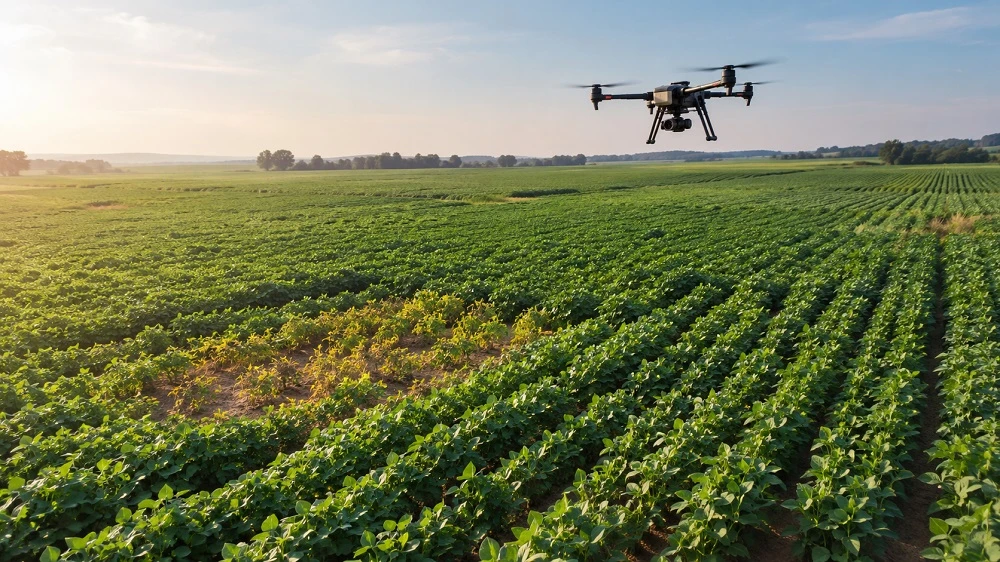
Drones sit between ground-based scouting and satellite monitoring. They can cover agricultural areas relatively quickly while collecting detailed imagery that is suitable for localized analysis.
For farmers, the benefit is not simply having more photographs. High-resolution aerial imagery can show how conditions vary within a field instead of reducing the crop to a single average measurement.
Consider a 100-acre field where most plants appear healthy but several smaller areas show abnormal patterns. A field-wide average could make those differences difficult to see. High-resolution imagery can provide a spatial view of where the variation occurs, after which AI analysis can help identify areas that warrant additional attention.
The result may be a map, alert, health indicator, or report rather than another folder of photographs. In practical terms, the value comes from making the collected imagery easier to interpret and use.
Sairone and the Move Toward Actionable Crop Intelligence
Platforms such as Sairone, developed by Saiwa, are designed to connect agricultural imagery with AI-based analysis and monitoring workflows.
Sairone’s crop-health capabilities are intended to help identify plant stress, pests, and disease-related issues and provide information that can be used in precision-management workflows. The platform includes plant-health indices, localized information, AI-supported recommendations, and outputs that can support targeted field operations.
For professional farmers, this can provide a more structured way to review crop conditions. Agricultural consultants and crop protection specialists can use the information alongside their own field assessments, while precision-agriculture companies and drone service providers can add an analytical layer to the imagery they collect.
The distinction is useful: the purpose is not simply to collect images or generate another visual report. The aim is to turn those images into information that can contribute to an agricultural decision.
From Detection to a Specific Location
Spatial information is one of the most useful aspects of digital crop monitoring.
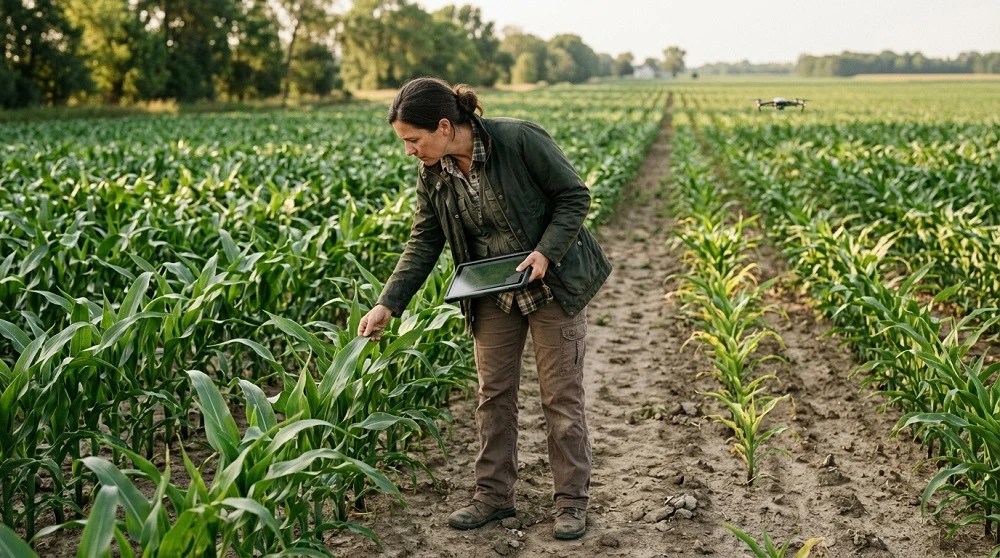
Knowing that crop stress exists is helpful, but knowing where it occurs makes the information more practical. Localized detection can help agricultural teams identify hotspots and decide which areas should receive additional attention.
For example, a farm manager may not need to inspect an entire field with the same level of intensity. Areas highlighted by a monitoring system can become priorities for a closer field inspection, especially when the findings are considered alongside crop stage, weather, field history, and other available information.
Localized information can also support more targeted treatment decisions. Instead of assuming that every part of a field needs the same intervention, agricultural professionals can use spatial data as one factor in determining where treatment or further investigation may be appropriate.
This approach fits naturally with precision agriculture, where decisions are made with greater attention to differences within individual fields.
Turning Insights Into Field Operations
The usefulness of monitoring depends on what happens after a potential problem is detected.
A dashboard can make crop-health information easier to review, but agricultural teams also need outputs that fit into their existing workflows. Reports and prescription maps can help bridge that gap.
A prescription map can identify areas of a field associated with a particular operation. When the map is compatible with the equipment and workflow being used, it can support more targeted applications instead of treating the whole field according to a single assumption.
In this process, AI may help detect patterns, identify locations, and organize information, while farmers, agronomists, and crop protection specialists determine the appropriate response.
That is a more practical way to view AI in agriculture. The technology can work as a decision-support layer within an existing management process, while agricultural professionals remain responsible for interpreting the results and deciding what action is appropriate.
Real-Time Does Not Mean No Human Involvement
The phrase “real-time insights” can sometimes suggest that an AI system automatically understands every field condition and immediately knows what should be done. In practice, agricultural conditions are more complicated.
Weather, crop variety, growth stage, field history, soil characteristics, and management practices can all affect how a particular signal should be interpreted. An anomaly detected in imagery is therefore not necessarily proof of a specific pest, disease, or other problem.
A detected anomaly can prompt an inspection. A health map can draw attention to an unusual area. A localized alert can help prioritize a scouting route. A prescription map can provide spatial information for a treatment plan.
The final decision still benefits from human expertise, particularly when the available data is incomplete or when similar visual symptoms can have different causes.
This becomes even more important as AI systems move from controlled research settings into commercial farming conditions. Scientific reviews continue to identify transferability and external validation as important considerations for operational deployment.
The Environmental and Economic Dimension
Better monitoring is not only about finding problems earlier. It can also support more targeted use of agricultural resources.
When farmers can distinguish between areas that may require intervention and areas that remain relatively healthy, they have more information available when deciding whether the entire field should be managed in the same way. Depending on the crop, problem, and management system, localized information may support more efficient use of inputs such as water, fertilizers, and crop-protection products.
There is also a labor consideration. Manual scouting across large areas takes time and personnel. AI-assisted analysis does not remove the need for field professionals, but it can help direct their attention toward locations that appear more relevant for closer examination.
For agricultural businesses, combining structured monitoring data with targeted field work can make large-scale crop monitoring easier to manage.
What Comes Next for Plant Health Monitoring?
Plant-health monitoring is moving toward greater integration. Drones, satellites, field sensors, weather information, machine learning, computer vision, and agricultural machinery can increasingly function as connected parts of the same information workflow.
Edge AI is another area of interest. By moving some computing closer to the point where data is collected, systems may be able to analyze information with less dependence on sending every dataset to a remote server first. This may be useful in areas where connectivity is limited, although the practical benefits depend on the system and operating environment.
AI models will also need to perform reliably across different crops, regions, growing conditions, and imaging environments. A model that works well under one set of conditions may not perform identically somewhere else.
For that reason, the future of agricultural AI is likely to depend less on a single breakthrough and more on how well different technologies, datasets, and agricultural workflows work together.
A More Informed Way to Read the Field
Farmers have always learned to read their fields. Modern technology adds more information to that process.
Instead of relying only on what can be seen during a field walk, agricultural professionals can combine direct observation with aerial imagery, plant-health indices, sensor data, machine learning, and spatial analysis.
The result is not a replacement for experience. It gives that experience more information to work with.
AI-powered plant health monitoring can help answer practical questions such as where crop stress is occurring, how extensive an affected area may be, which locations deserve closer inspection, and whether a pattern is changing over time. Those answers can help farmers and agricultural professionals decide where to direct attention and resources.
For farms and agricultural organizations dealing with increasingly complex monitoring requirements, this combination of field knowledge and data-driven analysis can make crop assessment more detailed and more consistent.
Sairone is one example of how AI can fit into this workflow by connecting crop imagery and intelligent analysis with information intended for practical agricultural use.
The goal is straightforward: make crop conditions easier to understand, make potential problems easier to locate, and give farmers better information for decision-making.
That is the practical value of smarter plant health monitoring. It does not need to replace the farmer’s judgment. It can give that judgment a more detailed view of the field.
Discover more from Life and Tech Shots Magazine
Subscribe to get the latest posts sent to your email.