

Custom Web Apps vs Ready-Made Platforms vs Vibe Coding: What Works Best?
Technology used to feel much easier to understand. If a business needed a website or an online tool, there were usually two obvious options: hire developers to build it from scratch, or use a website builder and launch something quickly.
Today, the choice is more interesting — and a little more confusing.
Now we have no-code platforms, low-code tools, ready-made SaaS products, AI coding assistants, vibe coding, and developers who use artificial intelligence every day to move faster. For a business owner, founder, marketer, real estate company, service provider, or startup team, the question is no longer just “Should we build a website?” The real question is:
What should we build, how should we build it, and who should be responsible for the result?
Let’s break it down in simple language.
What is a custom web application?
A custom web application is a digital product built specifically for your business. It is not just a template with your logo added. It is not a standard platform slightly customized to look different. It is software designed around your actual process, your users, your rules, your data, and your long-term goals.
A custom web app can be a customer portal, CRM system, booking platform, marketplace, online dashboard, real estate listing tool, internal management system, delivery platform, SaaS product, document workflow, or a complex e-commerce system.
The most important word here is custom.
That means your application can work the way your business works. If your sales process has five unusual steps, the software can follow those steps. If your customers need special user roles, the app can include them. If your team needs integrations with payment systems, maps, analytics, messengers, email, accounting software, or a CRM, those integrations can be planned and built properly.
A custom product is usually the best choice when software is not just a nice extra, but a serious part of the business. This is where Kavita Systems — Custom Web Development Services can help: building web solutions around real business processes, user needs, and long-term growth instead of forcing companies into generic templates.
Why businesses choose custom development
The biggest advantage of custom development is freedom. You are not trapped inside someone else’s template, menu, pricing plan, or feature list. You can design the product around your business model instead of changing your business model to fit a platform.
Custom development is especially useful when you need:
- unique business logic;
- different user roles and permissions;
- secure work with personal data;
- online payments;
- complex search and filters;
- automated workflows;
- integration with several external systems;
- high performance;
- a product that can grow over time.
For example, a simple real estate website can be built on a ready-made platform. But if you need advanced property search, agent dashboards, owner accounts, lead management, saved listings, map-based search, automated notifications, analytics, payment features, and internal moderation, custom development may make much more sense.
The same is true for other industries. A basic online store can be launched on a platform. But if pricing depends on location, customer type, stock availability, delivery logic, discounts, partner rules, and internal approvals, a custom system may be the smarter long-term choice.
Custom development gives you more control over design, performance, security, user experience, and future growth.
The downside of custom development
Custom development is powerful, but it is not magic. It usually takes more time, more planning, and more budget than using a ready-made solution.
A strong custom product needs discovery, design, architecture, development, testing, deployment, monitoring, and support. It also needs people who understand both technology and business goals.
That is why custom development is not always the right starting point. If you simply need a landing page, a small company website, a basic catalog, or a quick MVP, starting with a ready-made tool can be a very reasonable decision.
The biggest mistake is not choosing custom or ready-made. The biggest mistake is choosing without understanding the real purpose of the project.
What is a ready-made platform?
A ready-made platform is an existing tool that helps you launch a website, store, app, portal, or internal system faster. Instead of building everything from zero, you start with something that already exists and customize it.
This can include website builders, CMS platforms, e-commerce platforms, no-code tools, low-code systems, CRM platforms, form builders, automation tools, and industry-specific software.
Examples include platforms like WordPress, Shopify, Webflow, Wix, Tilda, Bubble, Retool, Power Apps, Bitrix24, and many others.
Some of these tools are very simple. Others are quite powerful. The main idea is the same: you use existing building blocks to create something useful faster.
Why ready-made solutions are popular
Ready-made solutions are popular for a very good reason: they save time.
A small business can launch a website in days. A startup can create a prototype before spending money on a full product. A company can test a new service, collect leads, publish content, sell products, or automate a simple internal process without hiring a full engineering team.
Ready-made platforms are great when the task is standard.
- You need a landing page? A builder can do it.
- You need a blog? A CMS can do it.
- You need a small online shop? An e-commerce platform can do it.
- You need a form to collect requests? A no-code tool can do it.
- You need a simple internal dashboard? A low-code platform might be enough.
For many businesses, this is the fastest and most practical way to start.
The limitations of ready-made platforms
The problems usually begin when the business grows or becomes more specific.
At first, a platform feels convenient. Then one day you need a feature that does not exist. Or you need to change the logic, but the platform does not allow it. Or you want to connect a specific system, but integration is limited. Or the monthly cost grows as your traffic, users, or features increase.
There can also be issues with performance, SEO flexibility, data ownership, security requirements, design restrictions, and vendor dependency.
This does not mean ready-made platforms are bad. They are simply not designed to solve every possible business problem. They are designed to solve common problems quickly.
That is why a ready-made platform is often the right choice for a first version, but not always the right choice forever.
What is vibe coding?
Vibe coding is one of the newest and most talked-about ideas in software development. In simple terms, it means using artificial intelligence to generate code based on natural language instructions.
Instead of writing every line manually, a person tells an AI tool what they want:
- “Create a login page.”
- “Build a booking app.”
- “Add payment processing.”
- “Make an admin dashboard.”
- “Fix this bug.”
- “Connect this form to a database.”
The AI then generates code. The person reviews the result, asks for changes, and keeps going through several iterations.
At its best, vibe coding feels fast, creative, and exciting. You can turn an idea into a working prototype much faster than before. You can test a concept, create a demo, or build a simple tool without starting from a blank page.
But there is an important difference between using AI as a helper and blindly accepting whatever AI creates.
When vibe coding is useful
Vibe coding can be very useful for early experiments.
If you have an idea and want to see what it might look like, AI can help you create a rough version quickly. If you need a small script, a simple interface, or a proof of concept, vibe coding can save a lot of time.
It is especially useful for:
- quick prototypes;
- startup demos;
- internal experiments;
- simple automation;
- drafting interface components;
- testing product ideas;
- learning how an app might be structured.
For non-technical founders, vibe coding can also make software feel less intimidating. You can describe your idea in normal language and see something appear on the screen.
That is powerful.
Where vibe coding becomes risky
The risk begins when vibe coding is treated like a full replacement for professional software development.
AI can generate code that looks correct but has hidden problems. It may create weak architecture, security issues, messy structure, poor performance, duplicated logic, or bugs that only appear later. It may also misunderstand the business rules or make assumptions that no one checked.
This is especially dangerous if the app handles:
- payments;
- personal data;
- user accounts;
- documents;
- medical, legal, or financial information;
- customer communication;
- large databases;
- third-party integrations;
- access permissions;
- business-critical workflows.
In these cases, “it seems to work” is not enough.
A real product needs testing, security review, architecture, backups, logging, error handling, documentation, deployment strategy, and long-term maintenance. AI can help with many of these things, but someone still needs to understand what is happening.
Developers with AI: the strongest modern approach
This brings us to the most important category: developers who use AI and understand what they are building.
This is not the same as blind vibe coding.
A professional developer with AI uses artificial intelligence as a powerful assistant. AI can help write routine code, generate tests, explain errors, suggest improvements, create documentation, refactor components, and speed up research. But the developer remains responsible for the final result.
The key difference is understanding.
A good developer does not just copy and paste AI-generated code into production. They check it. They test it. They think about the database, security, performance, user experience, architecture, and future maintenance. They know when the AI is helpful and when it is wrong.
This is where AI becomes a serious advantage instead of a risk.
Why developers with AI often win
A skilled developer using AI can move much faster than a developer working completely manually. At the same time, they can produce much better results than a non-technical person relying on AI blindly.
This approach combines speed with responsibility.
- AI can accelerate the work.
- The developer can protect the quality.
- The business can get a better product faster.
For many modern projects, this is the sweet spot.
You do not have to choose between slow traditional development and risky “AI magic.” You can choose a professional process where AI helps, but a human expert still makes the important decisions.
At Kavita Systems, we use this balanced approach to help businesses build faster while keeping the product reliable, scalable, and aligned with real business goals.
A simple comparison
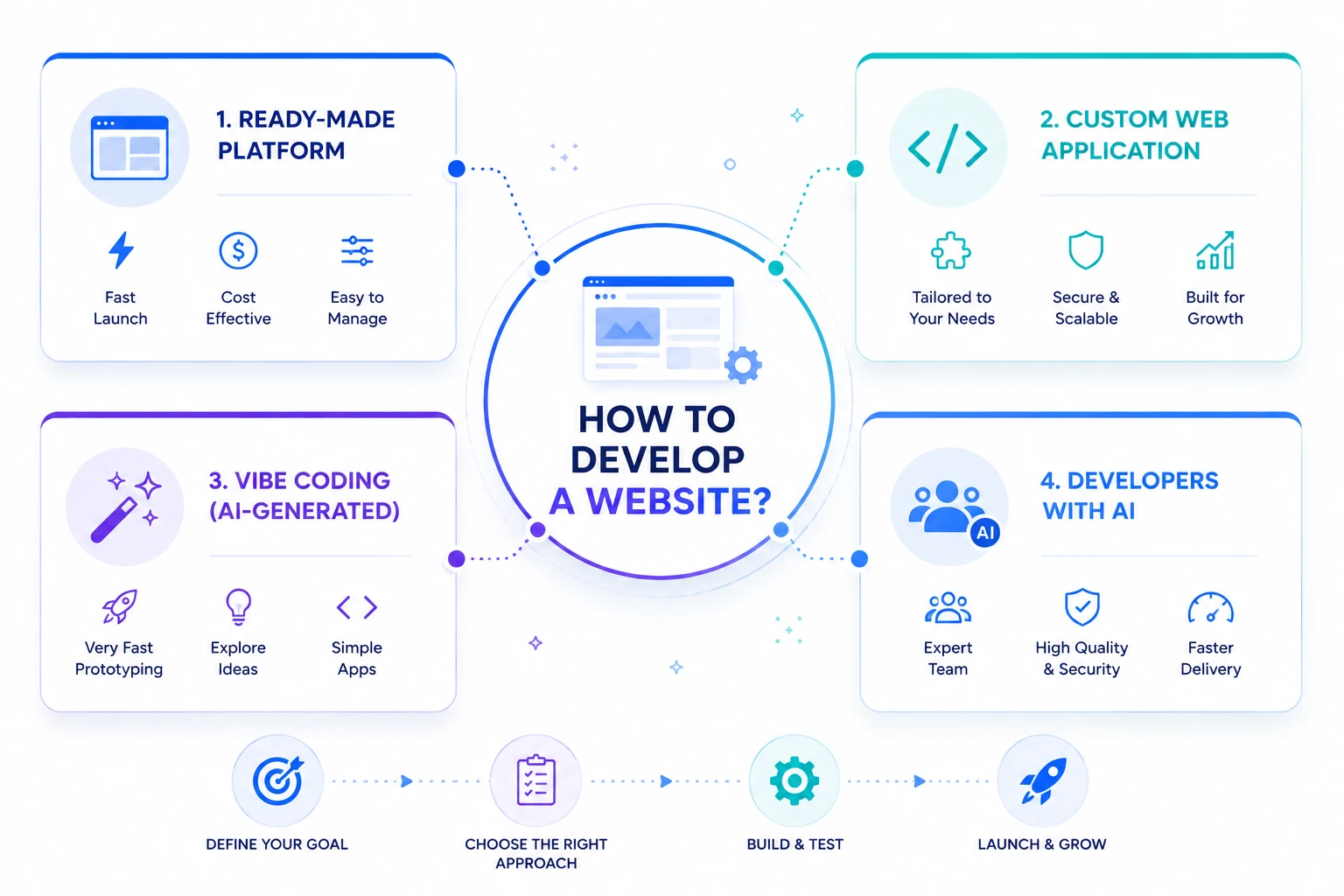
Here is the easiest way to think about the four options.
A ready-made platform is like renting a furnished apartment. You can move in quickly, everything basic is already there, and it is convenient. But you cannot rebuild the walls.
Custom development is like building a house for your family or your business. It takes more planning and investment, but it can be designed exactly for your needs.
Vibe coding is like asking a very fast assistant to sketch a house based on your description. You may get something useful quickly, but you still need an architect or builder to make sure it is safe and real.
A developer with AI is like an experienced architect using the best modern tools. The work becomes faster, but the quality still comes from expertise.
So, who is the winner?
There is no universal winner for every situation.
The real winner depends on the goal.
If you need something simple, fast, and affordable, a ready-made platform may be the winner. It is great for landing pages, small websites, blogs, catalogs, simple stores, and early MVPs.
If you need a serious product with unique logic, custom development is usually the winner. It gives you control, flexibility, and room to grow.
If you need to explore an idea quickly, vibe coding can be the winner. It is excellent for prototypes, demos, and experiments.
But if we are talking about a real business product where speed, quality, security, and future growth all matter, the strongest choice is usually this:
a developer or team that uses AI, but understands exactly what they are building.
That is the modern winner.
Not because AI replaces developers, but because good developers with AI can do more, move faster, and make better decisions.
How to choose the right option for your project
Before choosing a platform, developer, or AI tool, ask yourself a few practical questions.
What is the main goal of this project?
Is this a simple website or a real business system?
Will customers create accounts?
Will the product process payments?
Will it store personal data?
Does the business logic have unusual rules?
Will the project need to grow over time?
Do we need full control over design and functionality?
What happens if the system breaks?
Who will support it after launch?
If your project is mostly informational, a ready-made solution may be enough.
If your project is experimental, AI and vibe coding can help you move quickly.
If your project is operational, revenue-generating, or connected to customer data, you should be more careful. In that case, professional development matters.
And if you want both speed and quality, look for people who know how to work with AI properly — not people who simply ask AI to “make an app” and hope for the best.
A smart path for many businesses
For many companies, the best path is not one single approach. It is a combination.
Start simple when the risk is low.
Use ready-made tools for standard tasks.
Use AI to explore ideas and prototype faster.
Invest in custom development where your business is unique.
Work with developers who understand both technology and AI.
This approach saves money without sacrificing the future.
For example, a company might launch a marketing website on a ready-made platform, create an AI-assisted prototype for a new customer portal, and then build the final portal as a custom application with an experienced developer or team.
That is a practical, modern strategy.
The future of web development is not “templates only.” It is also not “AI will do everything by itself.” And it is not “every project must be built from scratch.”
The future is smarter than that.
Use ready-made solutions for standard needs.
Use vibe coding for fast experiments.
Use custom development for serious products.
Use AI as an accelerator.
And trust the final product to people who understand what they are building.
In other words: build simple things simply, build important things carefully, and let AI help smart people move faster.
That is how businesses can get better digital products today — without wasting time, money, or energy on the wrong approach.
Discover more from Life and Tech Shots Magazine
Subscribe to get the latest posts sent to your email.