
Finding a wooden box supplier in China sounds easy at first. Open a search engine, send a few inquiries, collect some quotations, and compare prices. In reality, the process is usually more complicated. Many suppliers can send beautiful photos and quick replies, but not every supplier can deliver stable quality, clear communication, safe packaging, and reliable production for real B2B orders.
For importers, wholesalers, retailers, and private label brands, choosing the right supplier is not only about finding a low price. It is about finding a partner who understands product requirements, can manage customization, and can reduce mistakes before they become expensive problems. Buyers who are exploring custom wooden packaging options can first review examples of custom wooden boxes to better understand common structures, finishes, and applications.
Here are the main points B2B buyers should check before placing an order for custom wooden boxes in China.
Understand what kind of wooden box you actually need
Before comparing suppliers, buyers should first be clear about the product itself. A supplier cannot quote accurately if the project is still vague.
For example, a gift box project is different from a storage box project. A promotional wooden box has different priorities from a premium retail packaging box. A tea box, cigar box, keepsake box, jewelry box, wine box, and wooden storage organizer may all look similar in photos, but they can require very different materials, structures, finishes, inserts, and packaging methods.
A good supplier will usually ask several basic questions before giving a serious quotation. They may ask about dimensions, target market, logo method, box structure, hardware, finish, packaging requirements, and quantity. This is usually a good sign. It shows the supplier is trying to understand the project rather than guessing.
Check material options carefully
Material is one of the most important parts of any wooden box project. Different wood species create very different results in cost, weight, appearance, durability, and production method.
Paulownia is often used for lightweight wooden boxes and cost-sensitive projects. It is light, easy to process, and suitable for painted or rustic styles. Pine is a common option for general wooden box production. It has a natural grain, moderate cost, and broad application. Acacia is usually positioned as a more premium material. It looks richer, feels heavier, and works well for gift-oriented or higher-end packaging and homeware projects.
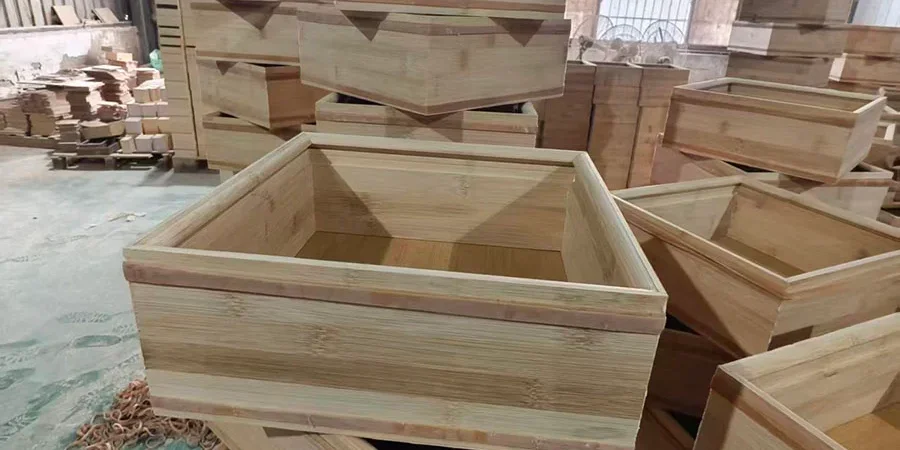
Some projects may also use bamboo, plywood, MDF with veneer, or solid walnut depending on the design and budget. Buyers should not ask only, what is your cheapest material. A better question is, which material is most suitable for this product, price target, and market positioning.
A reliable supplier should be able to explain the difference between materials in practical terms, not just send a list of names.
Review structure and construction details
A wooden box is not just a wooden box. Construction quality makes a big difference in how the product looks and performs.
Buyers should confirm details such as wall thickness, bottom structure, lid style, hinge type, corner joining method, magnet or clasp closure, insert material, and whether the box is intended for decorative use, retail packaging, shipping protection, or repeated daily use.
For example, a simple slide-lid box may be suitable for packaging or promotional use, while a hinged box with metal hardware and foam insert may be more suitable for gift sets or branded product presentation. A supplier that only shows finished photos but cannot explain the structure clearly may not be the best choice for OEM development.
At this stage, technical communication matters a lot. Clear drawings, reference photos, and sample confirmation are far more useful than broad promises.
Ask about MOQ in a realistic way
MOQ is one of the first topics buyers usually discuss, but it should not be treated as a fixed number for every project. MOQ often depends on material, box size, logo method, hardware, insert style, and packaging.
For example, a plain unfinished wooden box may have a lower MOQ than a custom lacquered gift box with EVA insert and logo plate. Buyers sometimes compare MOQ between different suppliers without checking whether the quotation is based on the same specifications. That can create confusion.
A professional supplier should explain why the MOQ is set at a certain level. In many cases, the MOQ is related to raw material purchasing, machine setup, hardware sourcing, packaging printing, or labor efficiency. When a supplier can explain this clearly, communication becomes easier and trust becomes stronger.
Confirm sample process and lead time
For custom wooden products, sampling is not a formality. It is the stage where most future production problems can be prevented.
A sample helps buyers confirm dimensions, material appearance, color, logo position, structure, and packaging details before mass production starts. It also shows how the supplier handles revisions and whether they are careful with details.
Buyers should ask about sample lead time, sample cost, revision process, and how many rounds of modification are possible. It is also useful to ask whether the sample will be made with final production material or with substitute material. That difference can matter a lot.
A supplier who treats sampling seriously will usually save the buyer time and money later.
Check customization ability beyond just logo printing
Many suppliers say they support customization, but the real question is how much customization they can handle well.
Custom wooden box development may involve size changes, new structures, custom inserts, engraved logos, printed logos, hot stamping, painted finishes, stained surfaces, unique hardware, window designs, sleeve packaging, gift box packaging, and barcode labels. Some buyers need retail-ready packaging. Others need safe bulk packaging for wholesale distribution. Some need both.
A capable supplier should be able to discuss these options in detail and suggest practical solutions based on budget and application. Good customization is not just about saying yes to every request. It is about knowing which solutions are stable, efficient, and realistic for production. Buyers who want to understand the wider sourcing background can also review a typical wooden products factory in China to see how supplier positioning, manufacturing scope, and OEM capability are usually presented.
Review packaging and shipping protection
This point is often underestimated. Even a well-made wooden box can become a problem if the packaging is poor.
For export orders, buyers should ask how the product will be packed inside the carton, whether protective materials are used, how hardware or corners are protected, and whether the supplier has experience with drop-sensitive products. Packaging should match the sales channel. Retail packaging, e-commerce packaging, wholesale master carton packing, and inner-box protection may all require different solutions.
A supplier with export experience should understand carton strength, product separation, insert options, moisture considerations, labeling, and pallet requirements when needed. This matters especially for orders going to the United States, Canada, Europe, and other overseas markets.
Evaluate communication quality, not just quotation speed
Fast quotation is useful, but communication quality is even more important. Buyers should notice how the supplier responds to questions. Are the answers specific or vague. Do they understand the structure of the product. Can they point out possible issues before production. Do they confirm details clearly.
In B2B orders, many problems come from misunderstanding rather than manufacturing failure. A supplier who communicates clearly, checks specifications carefully, and gives realistic timelines is usually more valuable than one who only promises the lowest price and fastest delivery.
Look for long-term production reliability
One good sample is not enough. Buyers should also evaluate whether the supplier can handle repeat orders, maintain stable quality, and manage production schedules.
Questions about workshop capability, quality control steps, hardware sourcing, moisture control, surface finishing, and final inspection are all reasonable. For long-term cooperation, consistency matters more than a one-time attractive quotation.
This is especially important for buyers building a private label brand or product line. The supplier should be able to support repeat production with controlled quality rather than treat each order like a completely new experiment.
Final thoughts
Choosing a wooden box supplier in China should be a practical business decision, not just a price comparison exercise. The right supplier should understand materials, structure, customization, packaging, and export requirements. They should also communicate clearly and handle sampling carefully before mass production begins.
For B2B buyers, a reliable supplier can help reduce defects, avoid delays, improve packaging safety, and make custom product development more efficient. In the long run, that kind of cooperation is usually worth far more than a small difference in unit price. Buyers who want to learn more about supplier capabilities, wooden homeware production, and OEM development can also visit Chic Homeware.
When evaluating suppliers, ask better questions, compare on the same specifications, and focus on long-term execution instead of short-term promises. That is usually the best way to choose a wooden box manufacturing partner that can truly support your business.
Discover more from Life and Tech Shots Magazine
Subscribe to get the latest posts sent to your email.